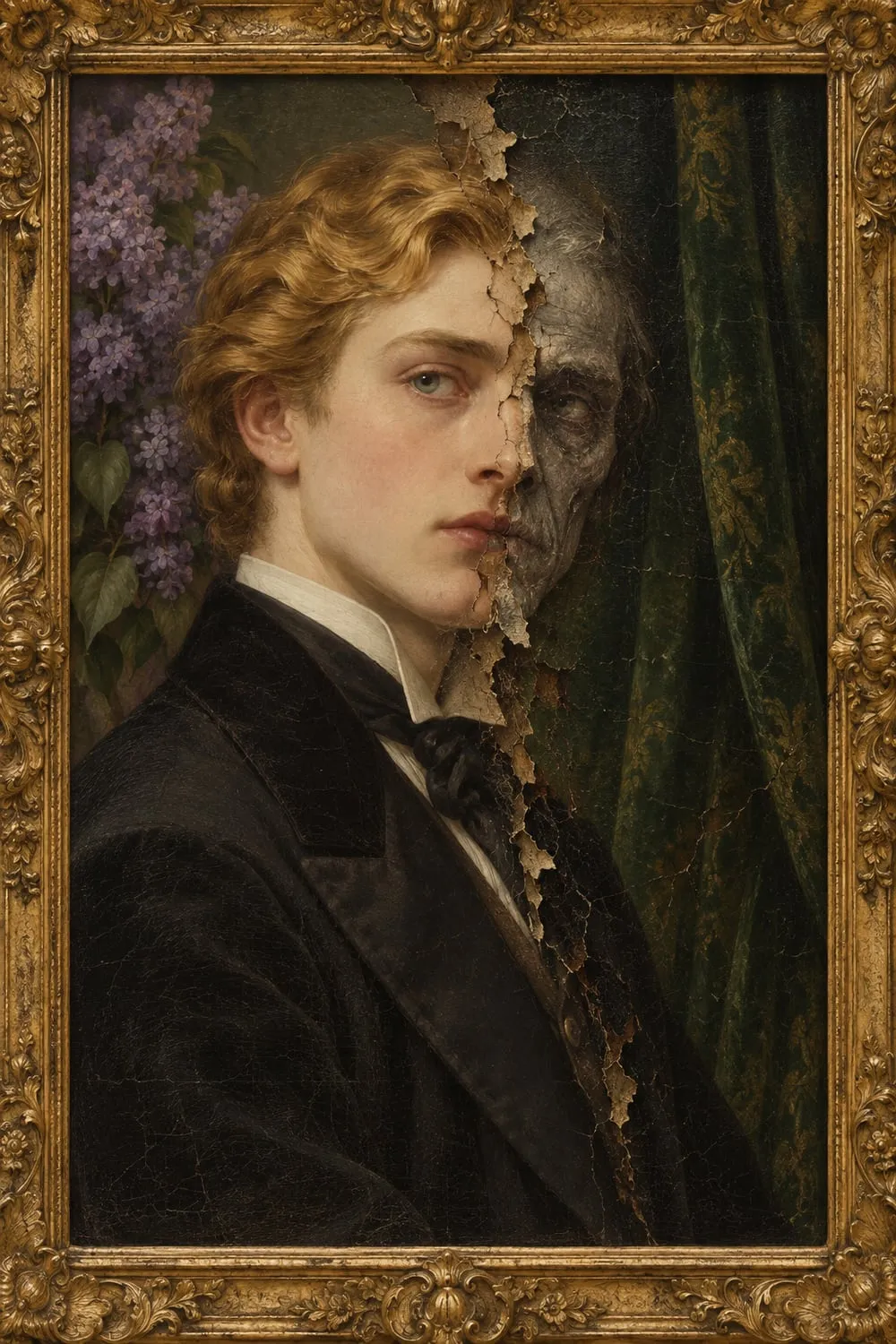
Summary
In his London studio, the painter Basil Hallward tells his friend Lord Henry Wotton why he will not exhibit his portrait of Dorian Gray: he has put too much of himself into it, and the young man has become his whole art. He begs Lord Henry not to influence Dorian. Dorian arrives, and while he poses Lord Henry talks to him of self-development, of yielding to temptation and of how quickly youth passes. When the portrait is finished, Dorian sees his own beauty for the first time and wishes aloud that he could stay young while the picture grows old: he would give his soul for it. Basil reaches for a palette-knife to destroy the canvas, but Dorian stops him.
Lord Henry learns from his uncle, Lord Fermor, that Dorian's mother, Lady Margaret Devereux, ran away with a penniless young officer who was killed in a duel arranged by her father, Lord Kelso, and that she died within a year. He resolves to dominate Dorian as Dorian, without knowing it, dominates Basil. A month later Dorian confesses that he loves Sibyl Vane, a seventeen-year-old actress who plays Shakespeare's heroines in a shabby little theatre and calls him Prince Charming. That night he telegraphs Lord Henry that they are engaged.
In the Vanes' lodgings in the Euston Road, Sibyl's mother reminds her of the money they owe the theatre manager, Mr. Isaacs. Sibyl's brother James, about to sail for Australia, distrusts him. On a walk in the park Sibyl glimpses Dorian driving past, but James misses him, and he swears to kill the man if he ever wrongs his sister. Before leaving, James makes his mother admit that she was never married to their father. Meanwhile Lord Henry and Basil dine with Dorian, who tells them of his engagement, and all three go to watch Sibyl play Juliet.
Sibyl acts badly. Afterwards she tells Dorian that now she knows real love she can no longer pretend on the stage. He tells her she has killed his love, calls her a third-rate actress with a pretty face and leaves her sobbing on the floor. At dawn he notices a touch of cruelty in the mouth of the portrait. Shaken, he resolves to marry her after all and writes begging her forgiveness, but Lord Henry arrives to tell him that Sibyl died in her dressing-room that night after swallowing poison. Lord Henry persuades him to see her death as a scene from a Jacobean tragedy, and Dorian decides to let the picture bear the burden of his shame. That evening he goes to the opera.
Next morning Basil is appalled by Dorian's calm and asks to see the portrait, which he now wants to exhibit in Paris. Dorian refuses, and draws from Basil a confession of how completely he once worshipped him. Dorian has the picture carried up to the locked schoolroom at the top of his house and covered with a purple and gold pall. The same day Lord Henry sends him a yellow book, a novel about a young Parisian who tries to live out the passions of every century but his own, and Dorian falls under its spell.
For years Dorian lives by the book. He studies perfumes, music, jewels, embroideries and church vestments, entertains brilliantly and slips away in disguise to dreadful places near the docks. Rumours spread and some men walk out of rooms he enters, yet his face stays innocent while the painted face grows old and vile. Sometimes he stands before the portrait with a mirror and takes pleasure in the contrast.
On the eve of his thirty-eighth birthday, Basil calls on him before leaving for Paris and confronts him with the ruined lives of his friends. When Basil says he would have to see Dorian's soul to know him, Dorian takes him upstairs and shows him the portrait. Basil begs him to pray. Seized by a sudden hatred, Dorian stabs him to death with a knife he had left in the room. Next day he summons Alan Campbell, a chemist and former friend, and forces him to destroy the body by threatening him with a letter whose contents are never revealed. A red stain like blood now glistens on the painted hand.
That evening Dorian dines at Lady Narborough's, burns Basil's coat and bag, and goes to an opium den near the river, where he meets the ruined Adrian Singleton. A woman calls him Prince Charming, and James Vane, about to sail for India, seizes him in an archway. Dorian saves himself by showing that his face is far too young for a man who knew Sibyl eighteen years before, though the woman then tells James the truth. A week later, at his country house, Selby Royal, Dorian faints on seeing James's face at the conservatory window. Three days on, Sir Geoffrey Clouston fires at a hare during a shooting party and kills a man in the thicket. It is James Vane, and Dorian weeps with relief.
Back in London, Dorian tells Lord Henry he means to be good: he has spared a village girl, Hetty, whom he had planned to take away with him. Lord Henry mocks the gesture, mentions Basil's disappearance and Alan Campbell's suicide, and laughs off the idea that Dorian could murder anyone. At home, Dorian smashes the mirror Lord Henry once gave him and goes to see whether his good deed has improved the picture. It has not: the face now shows cunning and hypocrisy, and the red stain has spread. Resolved to destroy the last evidence against him, he stabs the canvas with the knife that killed Basil. The servants hear a terrible cry. Breaking in, they find the portrait restored to its first beauty and, on the floor, a withered dead man whom they know only by his rings.
Chapter by chapter
SummaryWilde opens the novel with a string of aphorisms on art, artists and critics. He declares that there is no such thing as a moral or an immoral book, only books well or badly written, and that art mirrors the spectator rather than life. No artist, he says, has ethical sympathies or wishes to prove anything. The Preface closes on its most provocative line: 'All art is quite useless.'
Lord Henry Wotton lounges in Basil Hallward's studio, admiring Basil's full-length portrait of a beautiful young man and urging him to exhibit it. Basil refuses, confessing that he has put too much of himself into the picture and that its sitter, Dorian Gray, has become the whole of his art since they met at Lady Brandon's. Lord Henry is fascinated and recalls hearing the name at his aunt's. When Dorian arrives, Basil begs Henry not to influence him.
Dorian Gray meets Lord Henry in Basil's studio and, while posing, listens to Henry's talk of self-development, temptation and the shortness of youth. In the garden Henry urges him to live fully before his beauty fades, calling for 'a new Hedonism'. When Basil finishes the portrait, Dorian wishes the picture could grow old instead of him, saying he would give his soul for it. He stops Basil from destroying the canvas, then leaves for the theatre with Henry.
Lord Henry calls on his uncle, Lord Fermor, and learns that Dorian's mother, Lady Margaret Devereux, ran off with a penniless young officer who was killed months later in a duel her father, Lord Kelso, was said to have arranged; she died within a year. The story makes Dorian more interesting to Henry, who resolves to dominate him. At his Aunt Agatha's lunch Henry dazzles the table with a paradoxical praise of folly. Dorian, spellbound, breaks his promise to Basil and follows him out.
Waiting in Lord Henry's Mayfair library, Dorian meets Henry's flighty wife, Victoria. When Henry arrives, Dorian confesses that he loves Sibyl Vane, a young actress he discovered playing Juliet in a shabby little theatre and now watches every night in Shakespeare's heroines. Henry agrees to come and see her act, then reflects with pleasure that the boy is largely his own creation, a subject for experiment. That night a telegram announces Dorian's engagement.
Sibyl tells her mother she is in love with 'Prince Charming', whose real name she does not know, while Mrs Vane frets about their debt to the theatre manager, Mr Isaacs. Her brother James, about to sail for Australia, takes Sibyl for a walk in the park, where she glimpses Dorian driving past. James swears that if the stranger ever wrongs her he will kill him. Before leaving, he makes his mother admit that she was never married to their father.
As they meet to dine at the Bristol, Lord Henry tells Basil that Dorian is engaged to an actress, and Basil is dismayed. Dorian arrives glowing, describes Sibyl as Rosalind and their first kiss, and says her trust will make him good and free him from Henry's 'poisonous' theories. Henry answers with paradoxes on pleasure, goodness and selfishness. As they leave for the theatre, Basil follows alone in a hansom and feels that he has lost Dorian.
Sibyl plays Juliet so badly that the audience hisses and Lord Henry and Basil leave. Backstage she tells Dorian joyfully that real love has shown her the hollowness of acting and she can no longer pretend. Dorian coldly tells her she has killed his love and leaves her sobbing at his feet. Returning home at dawn, he sees a new touch of cruelty in the portrait's mouth, remembers his wish, and resolves to go back and marry her.
Dorian wakes late, finds that the portrait really has changed, and writes Sibyl a passionate letter begging forgiveness. Lord Henry arrives with the news that she was found dead in her dressing-room, having swallowed poison. Henry persuades him to see her death as a beautiful scene from a Jacobean tragedy rather than as his fault. Alone again, Dorian decides that the portrait will bear the burden of his shame while he keeps his youth, and goes to the opera.
Basil comes to console Dorian and is appalled that he went to the opera on the day he heard of Sibyl's death and now calls it a romantic tragedy. When Basil moves to look at the portrait and says he will exhibit it in Paris, Dorian threatens to end their friendship. Dorian then draws from him the confession that he worshipped Dorian and feared the picture showed it. Relieved that his own secret is safe, Dorian resolves to hide the portrait away.
Distrusting his valet Victor, Dorian gets the key of the old schoolroom from his housekeeper, Mrs Leaf, and wraps the portrait in a purple satin pall. The frame-maker Mr Hubbard and his assistant carry it to the top of the house, to the room built by the grandfather who hated him, and Dorian locks it away. A newspaper reports that the inquest has found Sibyl's death to be misadventure. Then Dorian loses himself in a strange, poisonous yellow book sent by Lord Henry.
Over many years Dorian shapes his life on the novel Lord Henry sent him, taking up perfumes, strange instruments, jewels, embroideries and church vestments in turn. In the locked room the portrait grows old and vile while his own face stays young, and he compares the two with a mirror. Rumours spread about his long absences, his haunts near the docks and the friends who now shun him, yet his beauty and wealth keep society on his side.
On a foggy November night, the eve of his thirty-eighth birthday, Dorian meets Basil Hallward, who is about to leave for Paris by the midnight train. In the library Basil confronts him with the scandals told of him in London: young men ruined, Lord Henry's sister disgraced, whispers of dreadful houses. Basil says he could only know the truth if he could see Dorian's soul. With a bitter laugh, Dorian offers to show it to him upstairs.
Dorian leads Basil up to the locked room and tears the curtain from the portrait. Basil recognises his own brushwork and signature on a hideous, ruined face and begs Dorian to pray with him for forgiveness. Seized by a sudden hatred, as if the picture had whispered it, Dorian stabs him to death with a knife lying on a painted chest. He hides Basil's bag and coat, fakes a late return for his valet Francis, and looks up Alan Campbell's address.
Dorian wakes calmly the next morning, reads Gautier to keep his mind from the body upstairs, and sends for Alan Campbell, a chemist and former close friend who now shuns him. Campbell refuses to help until Dorian writes him a note and threatens to send a letter whose contents are never revealed. Broken, Campbell does the work, while Dorian sees a red dew like blood on the portrait's hand and covers it. By evening the body is gone, leaving a smell of nitric acid.
That evening Dorian dines at Lady Narborough's, hiding his fever behind easy charm while Lord Henry trades epigrams on marriage and women with the hostess. Dorian cannot eat, and when Harry asks where he went the night before, he stumbles over his answer. At home he burns Basil's coat and bag, then takes a lacquer box of green paste from a hidden drawer. At midnight, dressed commonly, he hires a hansom and drives towards the river.
Dorian drives through the rain to an opium den near the quays, where he finds Adrian Singleton, cut off by his friends and content with his pipe. As Dorian leaves, a woman at the bar calls him Prince Charming, and a sailor rushes out after him. James Vane seizes him in an archway to avenge Sibyl, but Dorian's boyish face under the lamp convinces him he has the wrong man. The woman then tells James that Prince Charming ruined her nearly eighteen years ago.
A week later Dorian entertains a house party at Selby Royal. Over tea in the conservatory, Lord Henry and his cousin Gladys, Duchess of Monmouth, trade paradoxes about England, love and women, and he warns her that she is flirting with Dorian. Going to fetch her orchids, Dorian falls in a dead faint. He insists on coming down to dinner, but he is haunted by the face of James Vane, seen pressed against the conservatory glass.
Dorian hides indoors for two days in terror of James Vane, then persuades himself the face was only fancy. Out with the shooting party, he begs Sir Geoffrey Clouston to spare a hare, but Geoffrey fires into a thicket and kills a man hidden there. Dorian calls it a bad omen and resolves to leave Selby. Then the head-keeper reports that the dead man was an unknown sailor, and at the Home Farm Dorian finds the body of James Vane and rides home weeping with relief.
At Lord Henry's house, Dorian announces that he means to be good and has already spared Hetty, a village girl he loved. Lord Henry mocks the renunciation and gossips about Basil's disappearance, his own divorce and Alan Campbell's suicide. When Dorian asks what he would say to a confession that Dorian murdered Basil, Harry replies that crime is vulgar and beyond him. Harry praises Dorian's unchanged youth, and Dorian begs him never to lend that poisonous book to anyone again.
Walking home, Dorian hopes his one good deed has begun to cleanse the portrait. He smashes the mirror Lord Henry once gave him, then climbs to the locked room, where the face looks only more cunning and the blood on its hand brighter. Seeing that vanity and curiosity spared Hetty, he stabs the picture with the knife that killed Basil. The servants break in to find the portrait young and beautiful, and on the floor a withered, wrinkled dead man they know only by his rings.