Themes
Beauty and youth
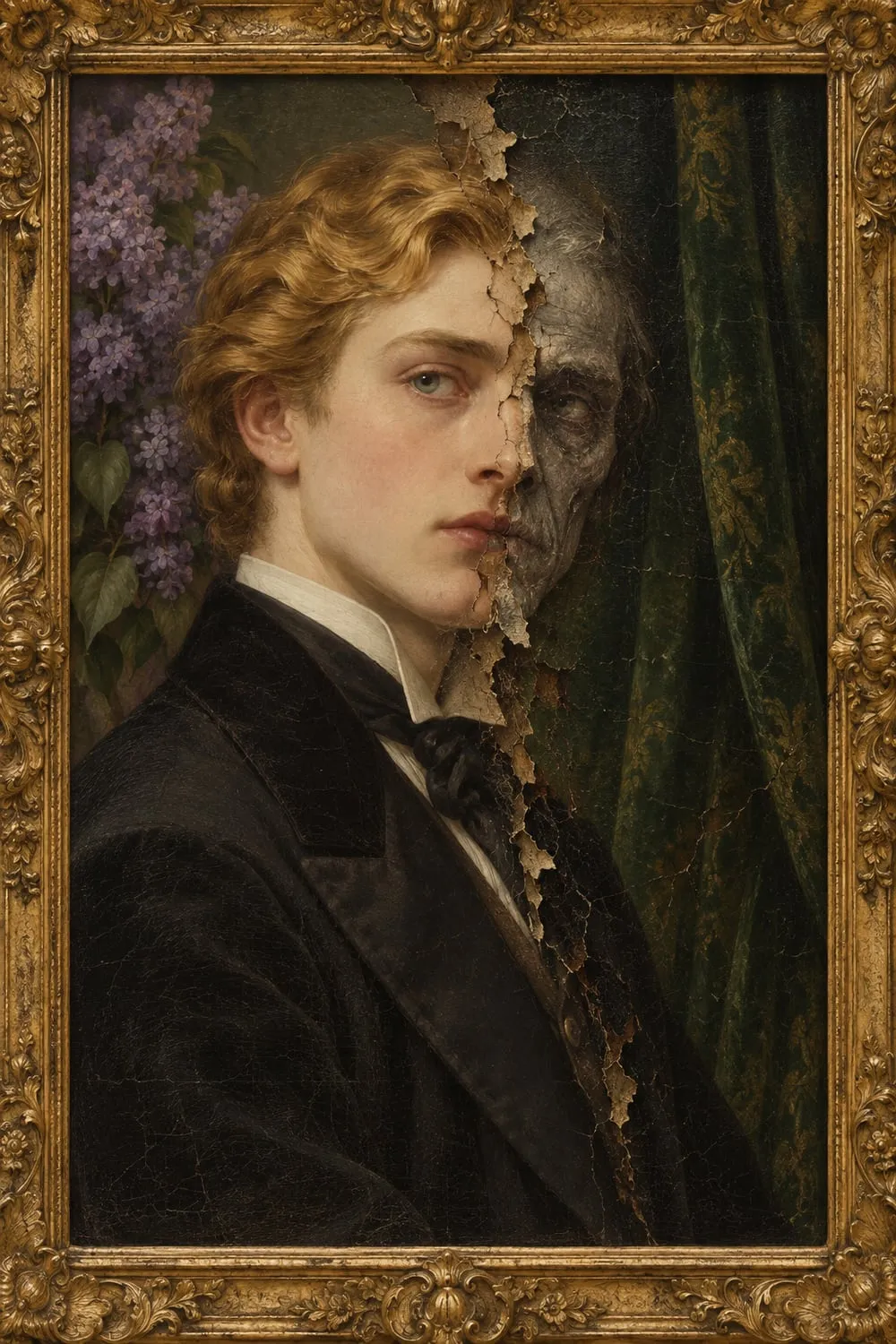
In Basil's garden Lord Henry tells Dorian that 'youth is the one thing worth having', and the finished portrait makes the lesson visible: Dorian sees his own beauty for the first time and cannot bear that the picture will keep what he must lose. His wish turns his face into a mask. Society trusts that face, so that men who talk grossly fall silent when he enters, and James Vane lets him go because he looks twenty. At the end Dorian smashes his mirror, deciding that his beauty and the youth he prayed for have ruined him.
Influence and corruption
Lord Henry tells Dorian that 'all influence is immoral', then spends the novel exerting it, treating the young man as an experiment whose results he watches with interest. His words in the studio, and later the yellow book he sends, work on Dorian like a slow poison; the narrator says plainly that 'Dorian Gray had been poisoned by a book.' The corruption passes on: Basil names the young men whose lives Dorian has wrecked, and Adrian Singleton turns up in an opium den. Lord Henry never accepts the charge. 'Art has no influence upon action,' he says on the last night of Dorian's life.
Art and life
The Preface insists that 'all art is quite useless' and that books are only well or badly written, yet the story turns on a picture with a moral life of its own. Sibyl Vane can play Juliet only while she knows nothing of love; once she loves Dorian, the painted scenery looks false to her, her acting collapses, and he loses interest in her. Lord Henry then teaches Dorian to watch her death as a spectator watches a play. Basil fears his portrait reveals 'the secret of my own soul'. In the end it reveals Dorian's.
Conscience and the soul
From the morning Dorian first sees cruelty in the painted mouth, the portrait becomes 'the visible emblem of conscience'. He hides it under a pall in his childhood schoolroom and leads a double life, celebrated host in society and disguised visitor to dens by the docks. Basil tells him that 'sin is a thing that writes itself across a man's face'. The novel agrees, but moves the writing to canvas. When Dorian spares Hetty and hopes the picture has softened, it shows only 'the curved wrinkle of the hypocrite', and his attempt to kill his conscience kills him.
Society and surfaces
Lord Henry says that 'it is only shallow people who do not judge by appearances', and the society around him bears him out. It 'feels instinctively that manners are of more importance than morals', and its luncheons and dinners, at Lady Agatha's or Lady Narborough's, run on wit and gossip about other people's marriages. Dorian's wealth and face protect him for eighteen years, even when he is nearly blackballed and the Duke of Berwick walks out of a smoking-room. The last scene makes the point bitterly: two passers-by hear the dying cry, learn whose house it is, and sneer.