Summary
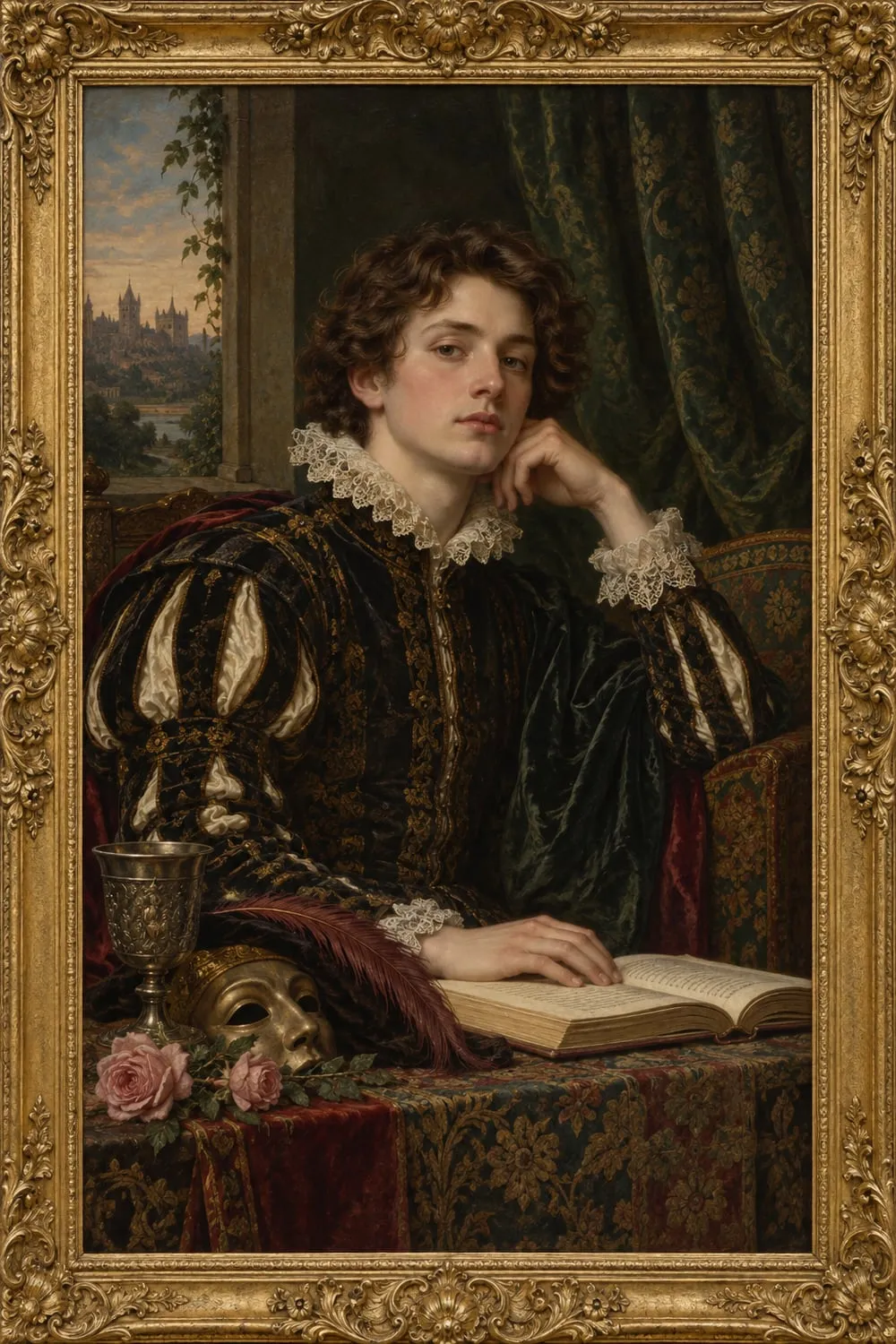
Dining with Erskine in Birdcage Walk, the young narrator argues that Chatterton's forgeries were art rather than crimes. Erskine asks what he would say of a young man who committed a forgery to prove a theory, and brings out a small panel portrait of a beautiful youth in late sixteenth-century dress, his hand on a book open at the dedication of Shakespeare's sonnets: 'the portrait of Mr. W. H.' He then tells the story of Cyril Graham, his friend at Eton and Trinity, a vain, fascinating young man who was the only perfect Rosalind Erskine ever saw and longed to go on the stage.
Cyril's theory, worked out from the sonnets alone, is that Mr. W. H. is neither Lord Pembroke nor Lord Southampton but Willie Hughes, a boy actor for whom Shakespeare wrote his great heroines. He finds 'Will' in the punning sonnets and 'Hughes' in the word 'Hews', printed with a capital and in italics in Sonnet 20. When weeks of searching the records produce nothing, Cyril returns from Warwickshire with the portrait, which he says he found clamped inside an old chest. Months later Erskine sees a drawing of it in the portfolio of a poor young painter, Edward Merton, whose wife blurts out that it was done for Cyril. The friends quarrel, and the next morning Cyril shoots himself, leaving a letter that offers his life as a sacrifice to the secret of the sonnets.
The narrator declares the theory 'the only perfect key' to the sonnets and vows to prove it. For weeks he works through the poems, adding discoveries of his own: that the marriage Shakespeare urges on the youth is marriage with his Muse, that the rival poet is Marlowe rather than Chapman, and that Hughes may have taken English drama to Germany and died there. He pours his arguments into a long letter to Erskine. As soon as he sends it, his belief vanishes.
He goes to apologise and finds that his letter has converted Erskine, who now means to devote his life to the theory. They part with a shadow between them, and Erskine goes to Germany. Two years later a letter from Cannes announces that Erskine, having failed to prove the theory, will die by his own hand for Willie Hughes. The narrator arrives to find him already buried, and learns from the English doctor that he died of consumption, having known for days that there was no hope. Lady Erskine gives the narrator the portrait, which now hangs in his library, where his friends take it for an Oudry. Sometimes, looking at it, he thinks there is a great deal to be said for the theory.