Themes
Faith and proof
The story is built around a single flaw, which Erskine names: 'You start by assuming the existence of the very person whose existence is the thing to be proved.' Cyril says he needs no proof and forges one only to satisfy his friend, joking that St. Thomas was the one apostle who did not deserve proof and the only one who got it. Belief passes from person to person like an infection and never stays put: each man loses his faith at the very moment he hands it on. Wilde makes the theory both persuasive and baseless.
Forgery and art
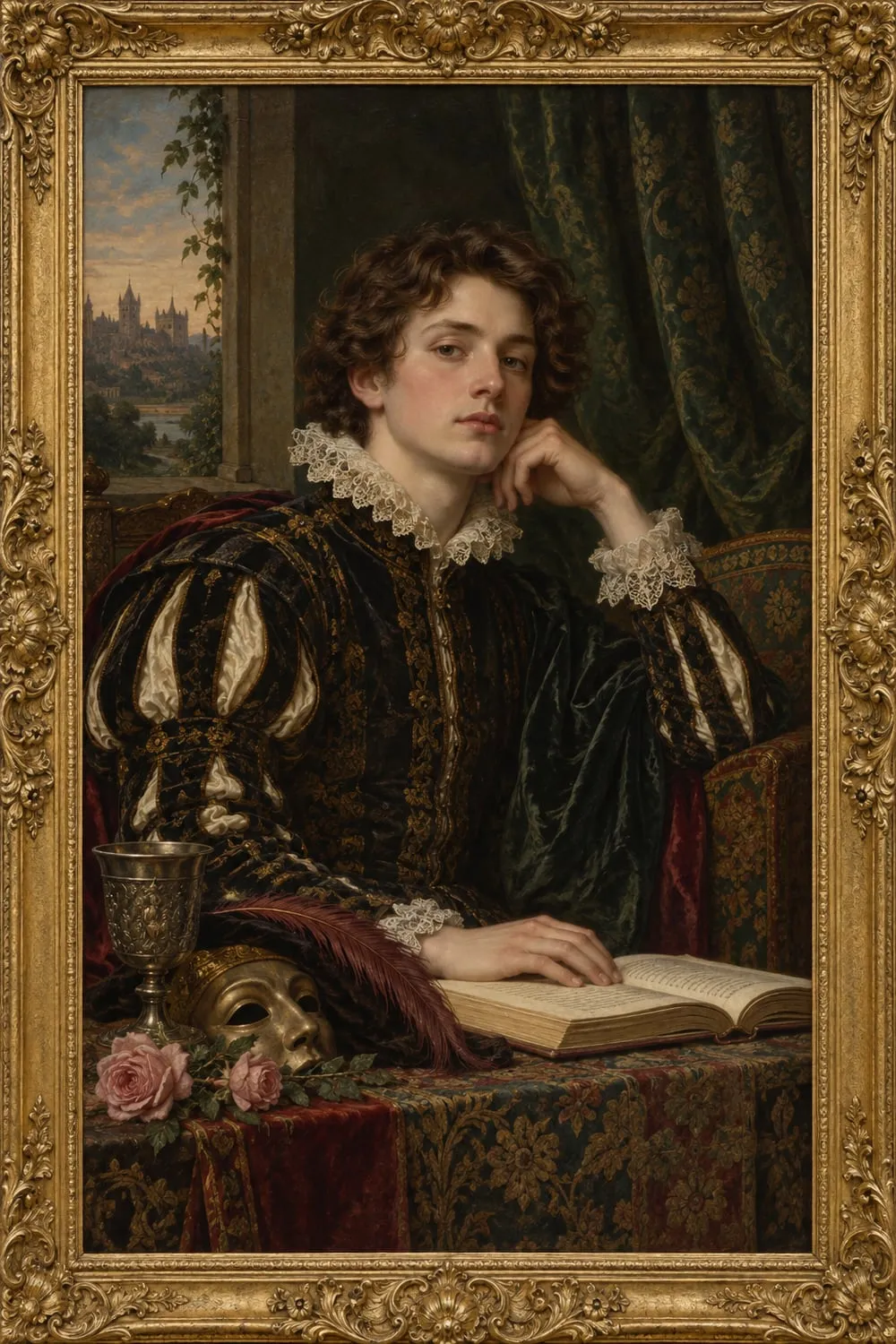
The opening argument sets the terms. The narrator defends Chatterton, saying that to 'censure an artist for a forgery was to confuse an ethical with an aesthetical problem', and Erskine answers with a forgery that ended in a death. The portrait is a fake, yet it is beautiful, persuasive and finally treasured. In the last paragraph it hangs in the narrator's library, where his artistic friends decide that 'it is not a Clouet, but an Oudry'. Wilde asks whether a thing made to deceive can still be true as art, and leaves the question open.
Acting and the actor
Cyril is himself a boy actor of a kind, always cast in the girls' parts at Cambridge and wild to go on the stage, and his theory makes Shakespeare's art depend on a player. The narrator's reading of the sonnets turns them into a study of the actor's temperament: Willie Hughes 'could act love, but could not feel it', one of those 'That do not do the thing they most do show'. The story opens with the claim that all art is 'to a certain degree a mode of acting', and every character in it performs a belief.
Beauty and devotion
Beauty drives everyone in the story. Cyril once read a paper 'to prove that it was better to be good-looking than to be good', and Erskine admits he was 'absurdly devoted to him'. The theory itself rests on a youth whose physical beauty 'became the very cornerstone of Shakespeare's art'. As the narrator falls under its spell he imagines Willie Hughes standing in his room, with golden hair and 'white lily hands', and compares him to Antinous and Charmides, youths whose beauty lives on in art. Devotion to beauty becomes devotion to an idea, and to a dead friend.
Dying for an idea
Two deaths frame the story, one real and one staged. Cyril shoots himself to show his faith in the theory, and Erskine, dying of consumption, writes that he will die by his own hand for Willie Hughes, hoping to force his friend to believe. The narrator is appalled: 'To die for one's theological beliefs is the worst use a man can make of his life, but to die for a literary theory!' Erskine had warned him that 'a thing is not necessarily true because a man dies for it', yet his own last act exploits exactly that feeling.