Summary
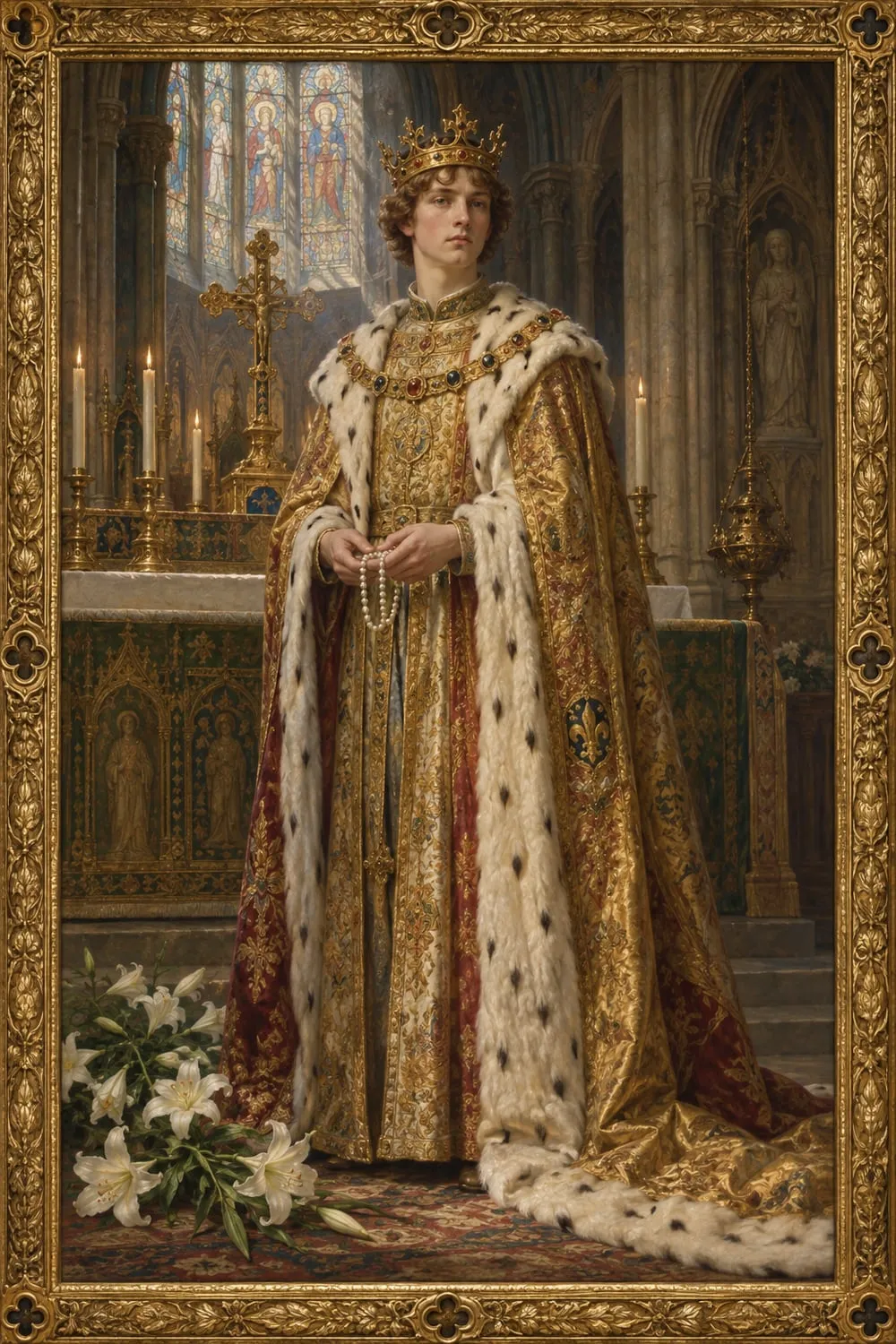
It is the night before the coronation of the young King, a lad of sixteen who until lately lived in the forest as the son of a poor goatherd. Rumour says he is the child of the old King's only daughter by a secret marriage with a man beneath her, stolen from her side at a week old; she died within an hour, and a murdered young man was said to lie in her grave. On his deathbed the old King acknowledged the boy as heir. In the palace he has fallen in love with beauty, kneeling before pictures and sending merchants across the world for rare and costly materials. Above all he thinks of his robe of tissued gold, his ruby crown and his pearl sceptre.
He sleeps and dreams. In a foul attic he watches starving weavers and sickly children, and a weaver tells him that the rich make slaves of the poor; the golden robe on the loom is for the young King's coronation. On a slave galley he sees a young diver sent down again and again for pearls until he brings up one shaped like the full moon and dies; the master says it shall be for the young King's sceptre. In a dried-up river bed he sees a multitude digging while Death and Avarice quarrel over them. When Avarice refuses Death a single grain of corn, Death sends Ague, Fever and Plague until no one is left alive. A pilgrim tells him they sought rubies for a king's crown, and in the pilgrim's mirror he sees his own face.
In the morning he refuses the robe, crown and sceptre and tells his courtiers his dreams. They think him mad, and the Chamberlain asks how the people will know him for a king without a king's raiment. He puts on his old leather tunic and sheepskin cloak, takes his shepherd's staff and makes a crown from a spray of wild briar. The nobles mock him, the people call him the King's fool, and a man in the crowd tells him bitterly that the poor live on the luxury of the rich, and that the name of the rich brother is Cain. His page grows afraid and leaves him.
At the cathedral the Bishop tells him that the world is full of evils no man can cure, and bids him go back and put on his robes. He strides past him and kneels before the image of Christ as the nobles burst in with drawn swords to kill him. When he rises, sunlight weaves him a robe fairer than the one made for him, his dead staff blossoms with lilies and the dry thorn with roses, and the Glory of God fills the place. The people kneel, the nobles sheathe their swords, and the Bishop kneels too, crying that a greater than he has crowned him. No man dares look upon his face, for it is like the face of an angel.