A comedy of blackmail, marriage and forgiveness
An Ideal Husband
"It is not the perfect, but the imperfect, who have need of love."
The story in brief
SummarySir Robert Chiltern is a rising statesman with a spotless name and a wife, Gertrude, who worships him for it. At his party in Grosvenor Square, Mrs Cheveley arrives from Vienna holding a letter that proves he sold a Cabinet secret to Baron Arnheim as a young secretary and built his fortune on the proceeds. She demands that he support a fraudulent Argentine Canal scheme in the House of Commons, or she will give the story to the newspapers.
Robert gives in, then withdraws his promise when his wife insists. Mrs Cheveley takes her revenge by telling Gertrude the truth, and the marriage breaks apart. Robert turns to his friend Lord Goring, an idle dandy who proves the sharpest mind in the play. Goring recognises a brooch Mrs Cheveley has lost as one she stole years ago, and uses it to force her to hand over the letter, which he burns. She slips away with a note Gertrude wrote to Goring, meaning to wreck the marriage with it.
The note misfires: Robert reads it as written to himself. Having denounced the canal scheme in the House, he is offered a seat in the Cabinet, and turns it down because Gertrude wants him out of public life. Goring persuades her that love means forgiving rather than punishing, and she lets Robert accept. Goring wins Robert's quick-witted sister Mabel, and the Chilterns begin again with the truth told.
Key themes
"To love oneself is the beginning of a lifelong romance, Phipps."
Summary
The play opens at an evening party in the octagon room of Sir Robert Chiltern's house in Grosvenor Square. Sir Robert, Undersecretary for Foreign Affairs, is admired for his integrity, and his wife Gertrude receives the guests at the top of the staircase. Society women trade languid complaints about their perfect husbands, Lord Caversham grumbles about his idle son Lord Goring, and Robert's sister Mabel defends Goring. Lady Markby arrives with a guest, Mrs Cheveley, lately of Vienna, and Lady Chiltern greets her coldly: they were at school together.
Mrs Cheveley draws Robert aside. She has invested heavily in an Argentine Canal scheme, which Robert calls "a commonplace Stock Exchange swindle" and means to condemn in the House the next night. She wants him to withdraw the report and speak for the scheme instead. Her weapon is a letter he wrote as secretary to Lord Radley, telling Baron Arnheim to buy Suez Canal shares three days before the Government announced its own purchase. Robert offers her any sum of money; she refuses, threatens to take the story to the newspapers, and he gives in. Before leaving, she tells Lady Chiltern that Robert will support the scheme.
Mabel finds a diamond brooch on the sofa, and Goring quietly pockets it, asking her to tell him if anyone claims it. Gertrude then questions her husband. She tells him Mrs Cheveley was sent away from school as a thief, insists that "One's past is what one is", and asks whether he hides any secret dishonour. He tells her there is nothing in his past she might not know, and at her insistence writes to Mrs Cheveley refusing to support the scheme. Left alone, he tells Mason to put out the lights.
The next day Robert confesses everything to Goring. Baron Arnheim, preaching "the gospel of gold", once promised to make him rich in return for private information; Robert sent him the state secret, received £110,000 and went straight into the House. He insists that yielding took courage, not weakness. Goring, who was once engaged to Mrs Cheveley for three days, urges him to tell his wife and to fight, and Robert wires the embassy in Vienna for anything scandalous about her. Goring then warns Gertrude that she makes too few allowances for weakness, and promises her his help if she is ever in trouble.
Lady Markby and Mrs Cheveley call to ask about a lost diamond snake-brooch with a ruby. Once Lady Markby has gone, Gertrude tells Mrs Cheveley she would never have invited her had she known who she was. Mrs Cheveley, learning that Gertrude forced Robert's letter of refusal, sets a deadline of noon the next day, and when ordered out of the house she reveals the truth as Robert walks in. He admits it. Gertrude recoils from "a horrible painted mask", and Robert answers that women ruin men by making "false idols" of them, then leaves her sobbing.
That night Goring receives a note from Gertrude on pink paper: "I want you. I trust you. I am coming to you. Gertrude." His father arrives to order him to marry, and Goring tells his butler Phipps to show a lady into the drawing room when she comes. It is Mrs Cheveley who calls, and while she waits she finds and reads the note. Robert then arrives in despair: Vienna has found nothing against her, except that Baron Arnheim left her most of his fortune. When a chair falls in the next room, Robert forces his way in, finds Mrs Cheveley and storms out, taking her for Goring's mistress, while Goring, believing the hidden woman is Gertrude, swears she is innocent.
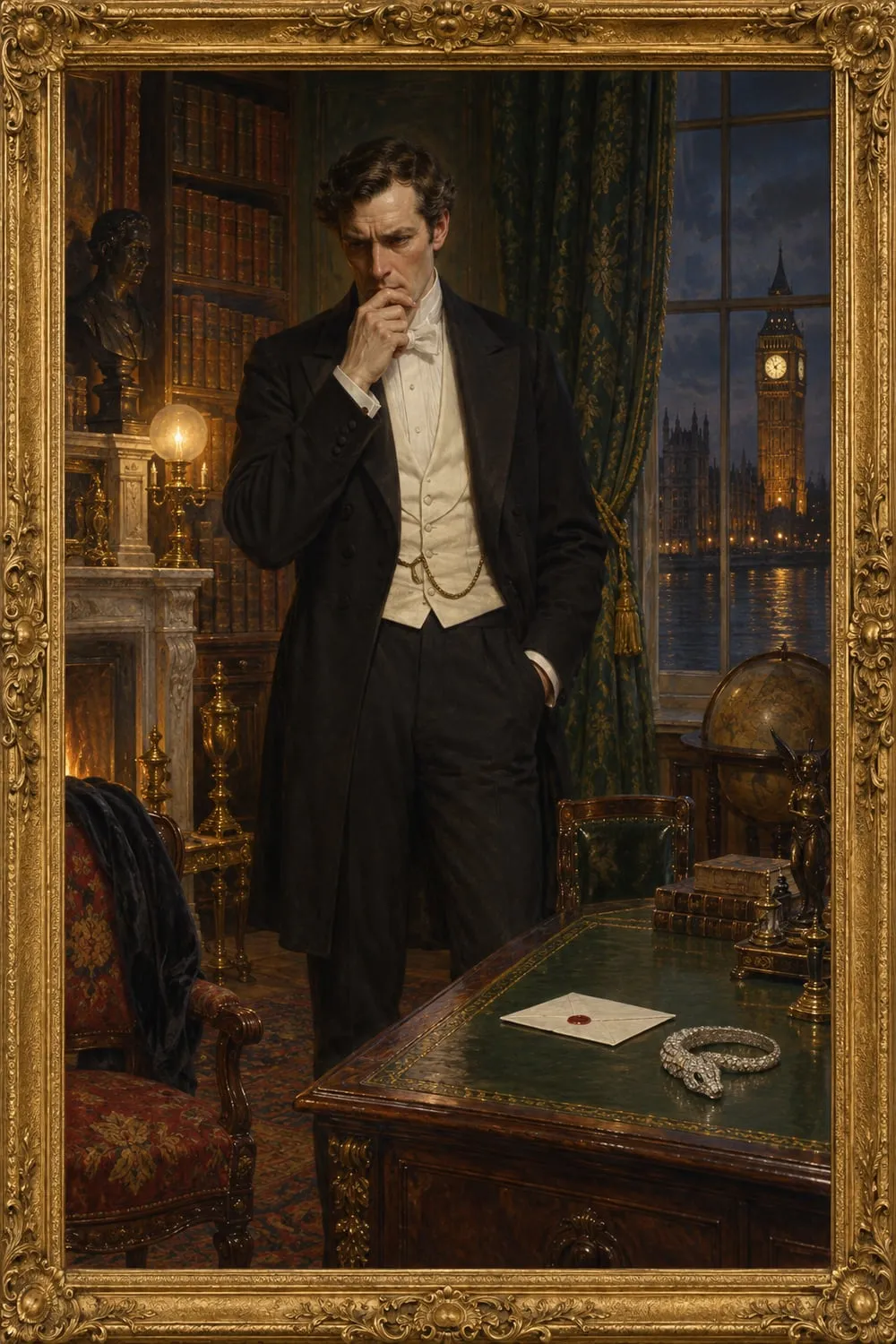
Mrs Cheveley offers Goring the letter if he will marry her, and he refuses. When she mentions her lost brooch, he produces it, clasps it on her wrist as a bracelet, and reveals that she stole it ten years earlier from his cousin, Lady Berkshire. Unable to find the hidden spring, and threatened with the police, she gives up Robert's letter, which Goring burns. While his back is turned she steals Gertrude's note, which she means to send to Robert as a love letter, and escapes by ringing for Phipps.
Next morning Lord Caversham reports that Robert has denounced the canal scheme in the House to the praise of The Times, and Goring proposes to Mabel, who accepts. Goring tells Gertrude that the letter is burnt but her note is stolen; before it can be intercepted, Robert enters reading it, takes it as written to him, and she lets him. He offers to leave public life, and declines the Cabinet seat that Lord Caversham brings from the Prime Minister. Goring persuades Gertrude to forgive rather than punish, and she tears up Robert's letter of refusal. When Robert forbids Goring to marry Mabel because of Mrs Cheveley's visit, Gertrude tells him the whole truth about the note. Robert consents, accepts the seat, and Gertrude assures him that what she feels is "Love, and only love."
Act by act
SummaryThe Earl of Caversham and his son Viscount Goring head the list, followed by Sir Robert Chiltern, Baronet and Undersecretary for Foreign Affairs, and the Vicomte de Nanjac of the French Embassy. The servants include Mason, the Chilterns' butler, and Phipps, Lord Goring's man. Lady Chiltern leads the women, with Mabel Chiltern and Mrs Cheveley last. The time is "The Present", the place London, and the action is completed within twenty-four hours.
At a party in Grosvenor Square, Mrs Cheveley, newly arrived from Vienna, tells Sir Robert Chiltern that she holds the letter in which he sold a Cabinet secret to Baron Arnheim. Unless he supports her fraudulent Argentine Canal scheme in the House, she will ruin him, and he gives in. Lord Goring pockets a diamond brooch that Mabel finds on the sofa. Lady Chiltern, who knew Mrs Cheveley at school, makes Robert write to her refusing.
The next day Sir Robert tells Lord Goring how Baron Arnheim's "gospel of gold" tempted him, and wires Vienna for scandal about Mrs Cheveley. Goring warns Lady Chiltern that she makes too few allowances for weakness, and offers her his help. Mrs Cheveley calls about her lost brooch and, ordered out of the house, exposes Robert to his wife. Robert admits the truth, blames Gertrude for making him an ideal, and leaves her sobbing.
Lord Goring receives a note from Lady Chiltern saying "I am coming to you", and tells Phipps to show the lady into the drawing room when she arrives. Mrs Cheveley comes instead, and Sir Robert, finding her hidden there, storms out believing her Goring's mistress. Goring traps her by clasping on her wrist a brooch she once stole, and burns Robert's letter. Before she leaves, she steals Gertrude's note to send to Robert.
Next morning Lord Caversham reports Sir Robert's triumphant speech against the canal scheme, and Lord Goring proposes to Mabel. Robert reads Gertrude's stolen note as a letter to himself, and she lets him. He declines a Cabinet seat to please her until Goring persuades her to forgive rather than punish, and she tears up his letter of refusal. Once Gertrude tells the truth about the note, Robert consents to Mabel's marriage and takes the seat.
Characters

Sir Robert Chiltern
The statesman with a secret
Undersecretary for Foreign Affairs at forty, admired for his integrity and adored by his wife. At twenty-two, as Lord Radley's secretary, he sold a Cabinet secret about the Suez Canal shares to Baron Arnheim for £110,000, the foundation of his fortune and career. He calls it courage rather than weakness, and hides it until Mrs Cheveley exposes him. He denounces her canal scheme in the House, and ends in the Cabinet, forgiven.

Lady Chiltern
The idealist who learns forgiveness
Gertrude Chiltern, twenty-seven, "a woman of grave Greek beauty" who works for the Woman's Liberal Association. She knew Mrs Cheveley at school as a thief and a liar. She loves Robert as an ideal and believes "One's past is what one is", so the truth nearly destroys their marriage. Her note to Goring is stolen and misread, and in the last act she learns to forgive, tearing up Robert's letter to the Prime Minister.

Lord Goring
The serious dandy
Arthur Goring, thirty-four but admitting to thirty-two, the son of Lord Caversham and "a flawless dandy" who changes his buttonhole and trades paradoxes with his butler. Beneath the pose he is the play's wisest and kindest figure. He urges Robert to tell his wife, offers Gertrude his help, and traps Mrs Cheveley, to whom he was once briefly engaged, with the brooch she stole. He ends engaged to Mabel.

Mrs Cheveley
The blackmailer from Vienna
Laura Cheveley, dressed in heliotrope and diamonds and "rather like an orchid", arrives from Vienna with Robert's old letter and a large stake in the Argentine Canal. She knew Baron Arnheim "Intimately" and inherited most of his fortune. Witty and unscrupulous, she offers the letter first for Robert's support, then for Goring's hand. Goring's bracelet trap defeats her, but she takes revenge by stealing Gertrude's note.

Mabel Chiltern
Youth and quick wit
Sir Robert's sister and ward, "the apple-blossom type" with "the fascinating tyranny of youth". She turns down Tommy Trafford's regular proposals, teases Goring without mercy and admits she has told "the whole of society" that she adores him. She accepts him in the last act, and gives the play its closing joke: an ideal husband sounds "like something in the next world", and she wants only to be "a real wife".

Lord Caversham
The exasperated father
The Earl of Caversham, seventy, wearing the star of the Garter, "A fine Whig type". He nags his son to marry and do something useful, calls him heartless, and hates paradoxes and draughts. In the last act he brings Robert the offer of a Cabinet seat, is baffled when it is refused, and warns Goring that if he fails to make Mabel an ideal husband he will cut him off with a shilling.

Lady Markby
The kindly gossip
A pleasant, popular society lady with grey hair "à la marquise" and good lace, who brings Mrs Cheveley to the Chilterns' party without knowing much about her. Her rambling talk covers her husband Sir John's political speeches, the Higher Education of Women and a friend's daughter engaged to a curate. She returns in the second act on the errand about the lost brooch and leaves Mrs Cheveley alone with Gertrude.

Vicomte de Nanjac
The Anglophile attaché
A young attaché at the French Embassy, "known for his neckties and his Anglomania". He greets Mrs Cheveley, whom he last saw in Berlin five years before, escorts Mabel to the music room and Lady Basildon to supper, and declares himself "very English in all my tastes". Goring calls him "the child-diplomatist". He appears only at the party in the first act.

Phipps
The ideal butler
Lord Goring's servant, described as "a mask with a manner" whose distinction is his impassivity. He answers his master's paradoxes with "Yes, my lord" and the odd dry remark of his own. Obeying orders to the letter, he shows Mrs Cheveley into the drawing room as the lady Goring expects, which sets up the disaster of the third act.

Baron Arnheim
The dead tempter
Never seen, and dead before the play begins. A Stock Exchange speculator of "subtle and refined intellect", he preached "the gospel of gold" to the young Robert in his Park Lane house, promised to make him rich for private information, and made three-quarters of a million from Robert's letter. Mrs Cheveley knew him intimately, inherited most of his fortune and kept the letter.
Themes
The past that returns
Nothing in the play stays buried. Robert's letter to Baron Arnheim, written eighteen years earlier, comes back from Vienna in Mrs Cheveley's hands, and she tells him "Even you are not rich enough, Sir Robert, to buy back your past." Lady Chiltern holds that "One's past is what one is," while Robert pleads that no one "should be entirely judged by their past." Mrs Cheveley's own past catches her too: the brooch she stole from Lady Berkshire ten years before becomes the trap that frees Robert. When Goring burns the letter, Robert wishes he had seen "that one sin of my youth burning to ashes."
Ideals and forgiveness
Lady Chiltern loves her husband as an ideal: "We women worship when we love; and when we lose our worship, we lose everything." When she learns the truth, Robert turns the charge back on her, arguing that women make "false idols" of men and that "It is not the perfect, but the imperfect, who have need of love." The last act tests whether an ideal can give way to forgiveness. Gertrude first wants Robert to give up public life as a penance, then tears up his letter to the Prime Minister: "You can forget. Men easily forget. And I forgive." Mabel has the final word on perfection, finding an ideal husband "like something in the next world."
Wealth, power and ambition
Robert's crime began with an argument. Baron Arnheim preached "the gospel of gold", teaching that power over other men was "the one thing worth having" and that only the rich possessed it. Robert still half believes him: "The God of this century is wealth," he tells Goring, insisting that he "bought success at a great price" and that yielding to such a temptation takes "strength and courage". Goring calls it "A thoroughly shallow creed." Mrs Cheveley, heir to most of the Baron's fortune, treats blackmail as "a commercial transaction". When she refuses Robert's money, Goring observes that "The rich can't do everything, after all."
Public virtue, private secrets
Robert tells his wife that "public and private life are different things", and Gertrude answers that they "should both represent man at his highest." Mrs Cheveley mocks England's "modern mania for morality", under which a scandal no longer adds interest to a man but crushes him. Goring explains why confession is impossible: a politician must be able to "talk morality twice a week to a large, popular, immoral audience". The irony peaks in the last act, when The Times praises Robert's "Unblemished career" as a "Noble contrast to the lax morality so common among foreign politicians", and he is offered a Cabinet seat for his "high moral tone".
The dandy as moralist
Lord Goring passes for the idlest man in London, and his father calls him "heartless" again and again. The stage directions see further, calling him "the first well-dressed philosopher in the history of thought." His paradoxes to Phipps about buttonholes, and about self-love as "a lifelong romance", are a pose. Beneath it he gives the play's most humane advice, telling Gertrude that "life cannot be understood without much charity". He alone solves the plot, recognising the stolen brooch and turning it into a bracelet Mrs Cheveley cannot remove. Even his proposal to Mabel he calls "a flash of genius", his first and, he promises, his last.
Men, women and marriage
The play is full of marriages under strain, from Lady Markby's complaints about Sir John's speeches to Mrs Marchmont's boredom with a husband "quite hopelessly faultless". Lady Chiltern is a political woman in her own right, working on "Factory Acts, Female Inspectors" and the franchise with the Woman's Liberal Association. Yet the ending turns on Goring's lecture that "A man's life is of more value than a woman's", which Gertrude repeats almost word for word as she tears up Robert's letter. Mabel is the counterweight: she refuses to marry "a man with a future before him", laughs at the idea of an ideal husband, and wants only to be "a real wife".
Quotes
"To love oneself is the beginning of a lifelong romance, Phipps."
Lord Goring · Act III
"Morality is simply the attitude we adopt towards people whom we personally dislike."
Mrs Cheveley · Act II
"I love talking about nothing, father. It is the only thing I know anything about."
Lord Goring · Act I
"Questions are never indiscreet. Answers sometimes are."
Mrs Cheveley · Act I
"Even you are not rich enough, Sir Robert, to buy back your past. No man is."
Mrs Cheveley · Act I
"An ideal husband! Oh, I don't think I should like that. It sounds like something in the next world."
Mabel Chiltern · Act IV
"Fashion is what one wears oneself. What is unfashionable is what other people wear."
Lord Goring · Act III
Context
An Ideal Husband was first performed at the Haymarket Theatre, London, on 3 January 1895. It is a play of its own moment: the persons page sets it in London at "The Present", and its plot runs through Parliament, the Foreign Office and the Stock Exchange. Robert's crime is tied to the British Government's real purchase of Suez Canal shares in 1875, and he dismisses the Argentine scheme as "a second Panama", recalling the failed French attempt to cut a canal at Panama, which had ended in financial scandal.
The play was still running when Wilde was arrested in April 1895, and his name was taken off the playbills. A play about a public man threatened with ruin went on playing while its author's name came off the bills. Mrs Cheveley's warning that "Not a year passes in England without somebody disappearing" reads differently in that light.
The play was published in 1899 by Leonard Smithers, credited to "the Author of Lady Windermere's Fan". For readers, Wilde added long descriptive stage directions, and they give the printed text much of its flavour. Lady Chiltern has "grave Greek beauty", Mrs Cheveley is "A work of art, on the whole, but showing the influence of too many schools", and Phipps is "a mask with a manner". Painters serve as reference points throughout, from Watteau and Boucher to Lawrence and van Dyck.
First performed at the Haymarket Theatre, London, on 3 January 1895; published 1899.
About this edition
- Text: the complete work from Standard Ebooks, released into the public domain (CC0 1.0). We change only the layout.
- Download the EPUB, free, for any e-reader.
- Audiobook: a full-cast reading by volunteers for LibriVox, in the public domain.
- Every quotation and glossary word in these notes is checked against the text.