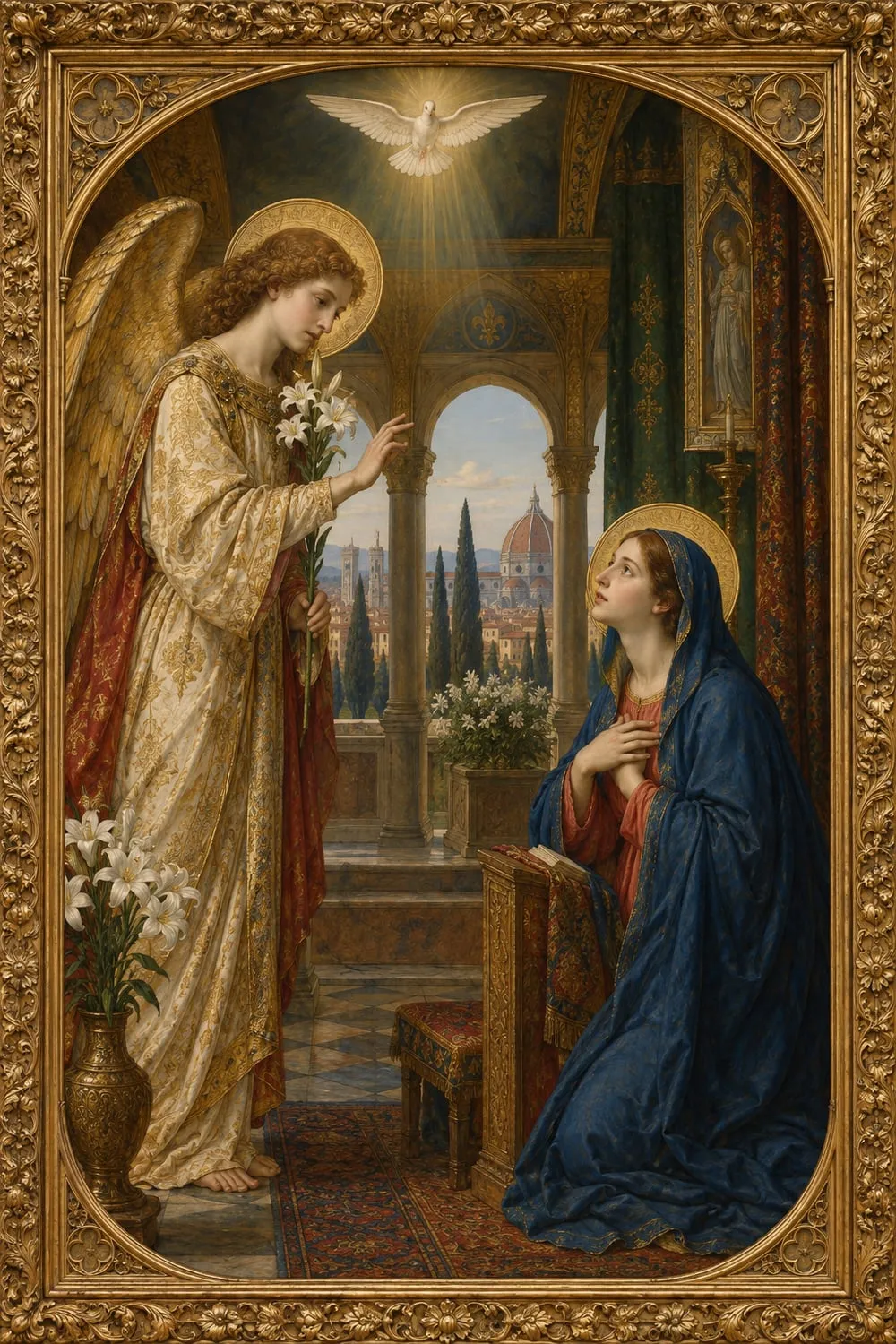
The Annunciation, seen through pagan eyes
Ave Maria Gratia Plena
"And over both the white wings of a Dove."
Poem
Was this His coming! I had hoped to seeA scene of wondrous glory, as was toldOf some great God who in a rain of goldBroke open bars and fell on Danae:Or a dread vision as when SemeleSickening for love and unappeased desirePrayed to see God’s clear body, and the fireCaught her brown limbs and slew her utterly:With such glad dreams I sought this holy place,And now with wondering eyes and heart I standBefore this supreme mystery of Love:Some kneeling girl with passionless pale face,An angel with a lily in his hand,And over both the white wings of a Dove.
Florence.
In brief
SummaryThe speaker comes to a holy place expecting God's coming to look like the great visitations of Greek myth: the god who fell on Danae in a rain of gold, or the fire that destroyed Semele when she begged to see her divine lover's body. Instead he finds a quiet scene of the Annunciation, the moment named in the Latin title, 'Hail Mary, full of grace'. There is only a kneeling girl with a pale face, an angel holding a lily, and the white wings of a dove above them. The sonnet turns on that surprise: the 'supreme mystery of Love' is still, gentle and plain.
Key themes
"Was this His coming! I had hoped to see"
Summary
The sonnet opens with an exclamation that is half question: 'Was this His coming!' The speaker had hoped for 'A scene of wondrous glory', like the Greek stories of gods coming down to mortal women. He remembers the 'great God who in a rain of gold Broke open bars and fell on Danae', and Semele, 'Sickening for love and unappeased desire', who prayed to see 'God's clear body' and was killed when the fire 'Caught her brown limbs'.
The last six lines bring him into the present. He came to 'this holy place' with 'such glad dreams', and now he stands 'with wondering eyes and heart' before 'this supreme mystery of Love'. What he sees is very simple: 'Some kneeling girl with passionless pale face', an angel with a lily in his hand, and over both 'the white wings of a Dove', the traditional sign of the Holy Spirit.
The poem never says whether the speaker is disappointed or moved. The first line can be read either way, and the word 'wondering' suggests that the plainness of the scene becomes its own kind of wonder. The place name Florence, printed at the foot, sets the speaker in the Italian city.
Characters
The speaker
The expectant visitor
A visitor to a holy place in Florence whose imagination is shaped by Greek myth. He hoped to see God come in gold or fire, as in the stories of Danae and Semele. Standing before the real scene, he looks 'with wondering eyes and heart', unsure at first what to make of its simplicity.
The kneeling girl
Mary at the Annunciation
The figure at the centre of the scene, 'Some kneeling girl with passionless pale face'. The title names her as Mary, greeted by the angel, but the poem gives her no name and no words. Her stillness is the answer to the speaker's dreams of divine fire and desire.
The angel
The messenger with the lily
The angel of the Annunciation, shown simply as 'An angel with a lily in his hand'. He is the bearer of the greeting in the title. With the girl and the dove above them, he completes the plain picture that replaces the speaker's hopes of splendour.
Themes
Pagan myth and Christian mystery
The first eight lines are filled with Greek myth, the last six with a Christian scene. Danae's 'rain of gold' and Semele's burning are stories of gods who come to women in splendour and violence. The Annunciation is the Christian story of God coming to a woman, and the sonnet sets the two side by side to show the difference: in place of fire and gold there is 'Some kneeling girl', a lily and a dove.
Expectation and surprise
The speaker arrives 'With such glad dreams', wanting either 'A scene of wondrous glory' or 'a dread vision'. What he meets is quiet and pale. The opening cry, 'Was this His coming!', holds both let-down and awe, and the poem lets the reader feel the gap between what the imagination wants from the holy and what the holy turns out to be.
Desire and stillness
The myths the speaker loves are full of passion: Semele is 'Sickening for love and unappeased desire', and her 'brown limbs' are consumed by fire. The girl at the centre of the Christian scene has a 'passionless pale face'. The contrast between burning desire and white calm runs through the whole sonnet, down to the colours: gold and fire in the first half, white wings and a lily in the second.
Context
Ave Maria Gratia Plena is a sonnet in the Rosa Mystica group of Wilde's Poems, published by David Bogue in 1881. Its Latin title, 'Hail Mary, full of grace', is the angel's greeting to Mary and the opening of the Hail Mary prayer. The word Florence is printed at its foot. The first eight lines are given to Greek myth and the last six to the Christian scene, so the turn of the sonnet is also the turn from one world to the other.
About this edition
- Text: the complete work from Standard Ebooks, released into the public domain (CC0 1.0). We change only the layout.
- Download the EPUB of the whole book it comes from, free, for any e-reader.
- Every quotation and glossary word in these notes is checked against the text.