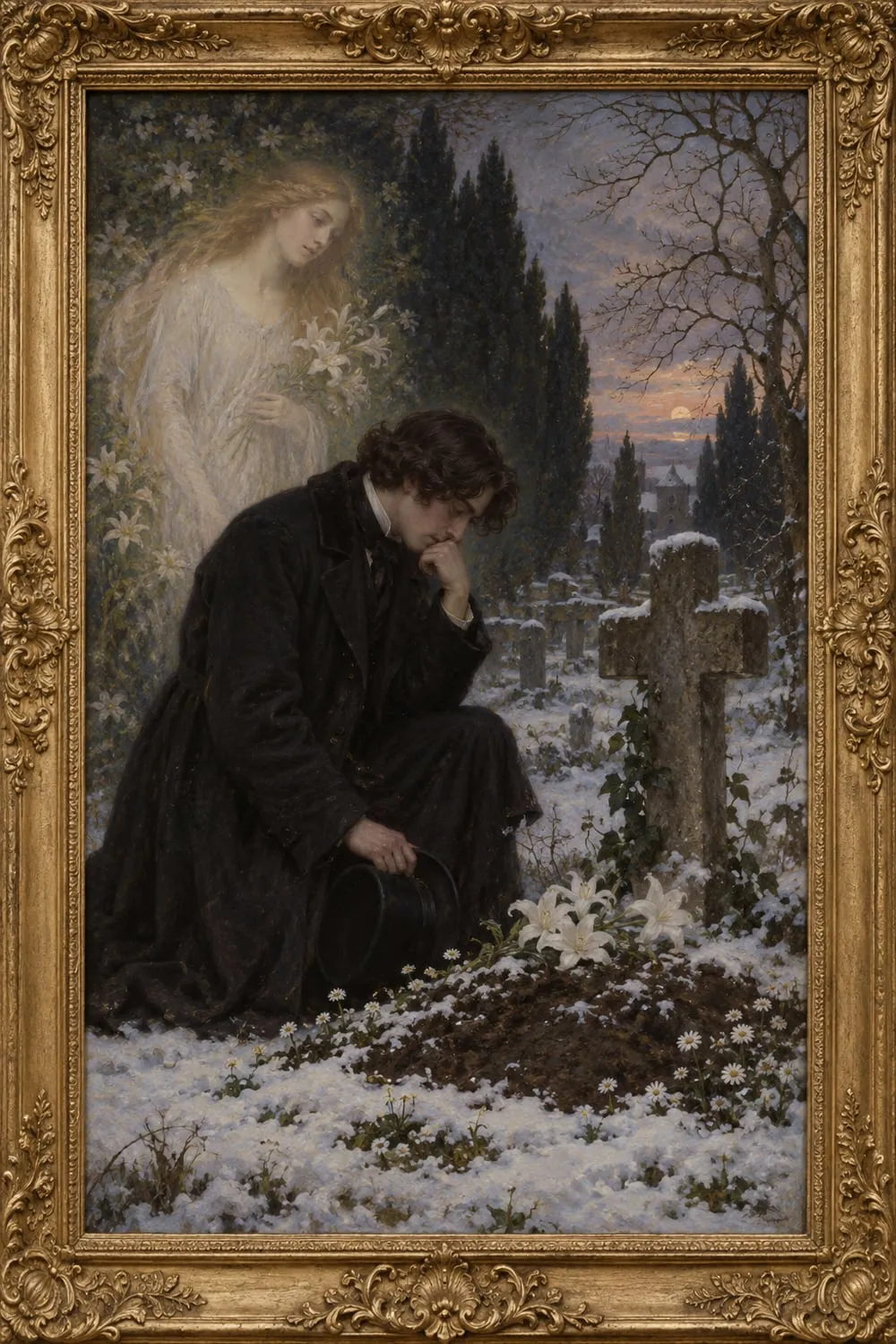
A quiet lament over a young grave
Requiescat
"Tread lightly, she is near"
Poem
Tread lightly, she is nearUnder the snow,Speak gently, she can hearThe daisies grow.
All her bright golden hairTarnished with rust,She that was young and fairFallen to dust.
Lily-like, white as snow,She hardly knewShe was a woman, soSweetly she grew.
Coffin-board, heavy stone,Lie on her breast,I vex my heart alone,She is at rest.
Peace, Peace, she cannot hearLyre or sonnet,All my life’s buried here,Heap earth upon it.
Avignon.
In brief
SummaryA short elegy in five quatrains, spoken at the grave of a young woman. The speaker asks those present to tread lightly and speak gently, since she lies near 'Under the snow' and 'can hear / The daisies grow'. Her golden hair is 'Tarnished with rust', and she who was young and fair has 'Fallen to dust'. She grew so sweetly, 'Lily-like, white as snow', that she hardly knew she was a woman. The last stanzas set her rest against the speaker's grief, ending: 'All my life's buried here, / Heap earth upon it.'
Key themes
"Speak gently, she can hear"



Summary
The first stanza asks for quiet: 'Tread lightly, she is near / Under the snow, / Speak gently, she can hear / The daisies grow.' The second sets her beauty against decay: 'All her bright golden hair' is 'Tarnished with rust', and 'She that was young and fair' has 'Fallen to dust'. The third remembers her innocence: 'Lily-like, white as snow, / She hardly knew / She was a woman, so / Sweetly she grew.'
In the fourth stanza the speaker lets the coffin-board and the heavy stone lie on her breast, for 'I vex my heart alone, / She is at rest.' The last stanza turns from her to the speaker's own loss. She cannot hear 'Lyre or sonnet', so no poem can reach her, and the speaker ends by saying that 'All my life's buried here', and asking that earth be heaped upon it. The grave holds two lives: hers, which is over, and the speaker's, which is buried with her.
Characters
The young woman
Young and fair, now dust
The one who lies 'Under the snow', her golden hair now 'Tarnished with rust'. She grew so sweetly, 'Lily-like, white as snow', that she 'hardly knew / She was a woman'. Now she is at rest, beyond the reach of 'Lyre or sonnet'.
The mourner
The grieving speaker
The voice at the graveside, who asks others to tread lightly and speak gently. The mourner's grief is private, 'I vex my heart alone', and complete: 'All my life's buried here'.
Themes
Gentle grief
The poem's manner is as quiet as its request: short lines, plain words, and commands to 'Tread lightly' and 'Speak gently'. The dead girl is imagined as still sensitive, able to hear 'The daisies grow', so the mourners' steps must be soft. Grief here speaks in a hush rather than a cry.
Innocence and decay
The poem sets images of purity against the grave. She was 'Lily-like, white as snow', so young she 'hardly knew / She was a woman', yet her 'bright golden hair' is now 'Tarnished with rust' and she has 'Fallen to dust'. The same snow that stands for her whiteness lies over her grave.
The mourner's buried life
The last two stanzas turn from her to the speaker. She 'is at rest' while 'I vex my heart alone'; she cannot hear 'Lyre or sonnet', so even poetry fails her; and the final lines bury the speaker's own life with her: 'All my life's buried here, / Heap earth upon it.'
Context
The poem belongs to 'Rosa Mystica', a group within Wilde's collected poems, and ends with the place name 'Avignon'. Its Latin title, the word used in the prayer for the dead, means 'may she rest', and the fourth stanza echoes it: 'She is at rest.' It is written in five short quatrains, each alternating longer and shorter lines.
About this edition
- Text: the complete work from Standard Ebooks, released into the public domain (CC0 1.0). We change only the layout.
- Download the EPUB of the whole book it comes from, free, for any e-reader.
- Every quotation and glossary word in these notes is checked against the text.