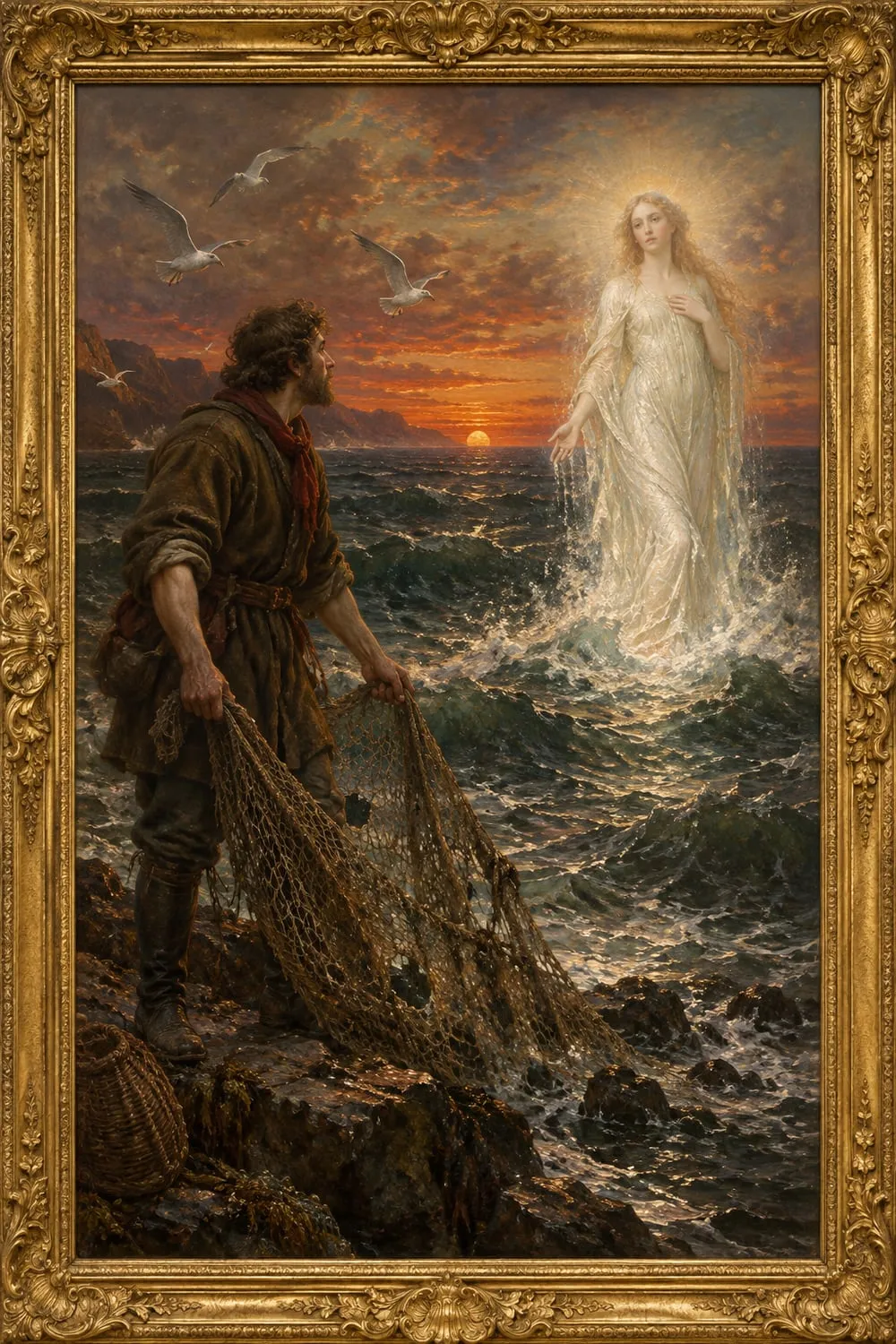
From a barren sea, a sudden glory
Vita Nuova
"I stood by the unvintageable sea"
Poem
I stood by the unvintageable seaTill the wet waves drenched face and hair with spray,The long red fires of the dying dayBurned in the west; the wind piped drearily;And to the land the clamorous gulls did flee:“Alas!” I cried, “my life is full of pain,And who can garner fruit or golden grainFrom these waste fields which travail ceaselessly!”My nets gaped wide with many a break and flaw,Nathless I threw them as my final castInto the sea, and waited for the end.When lo! a sudden glory! and I sawFrom the black waters of my tortured pastThe argent splendour of white limbs ascend!
In brief
SummaryThe speaker stands at evening by a sea that yields no harvest, drenched with spray, while the sun sets in red fire and the gulls fly for land. He cries that his life is full of pain and that nothing can be gathered from its 'waste fields'. His nets are torn, but he throws them one last time and waits for the end. Then comes 'a sudden glory': out of 'the black waters of my tortured past' he sees white limbs rise in silver splendour. The title promises a new life, and the vision arrives at the moment of deepest despair.
Key themes
"I stood by the unvintageable sea"
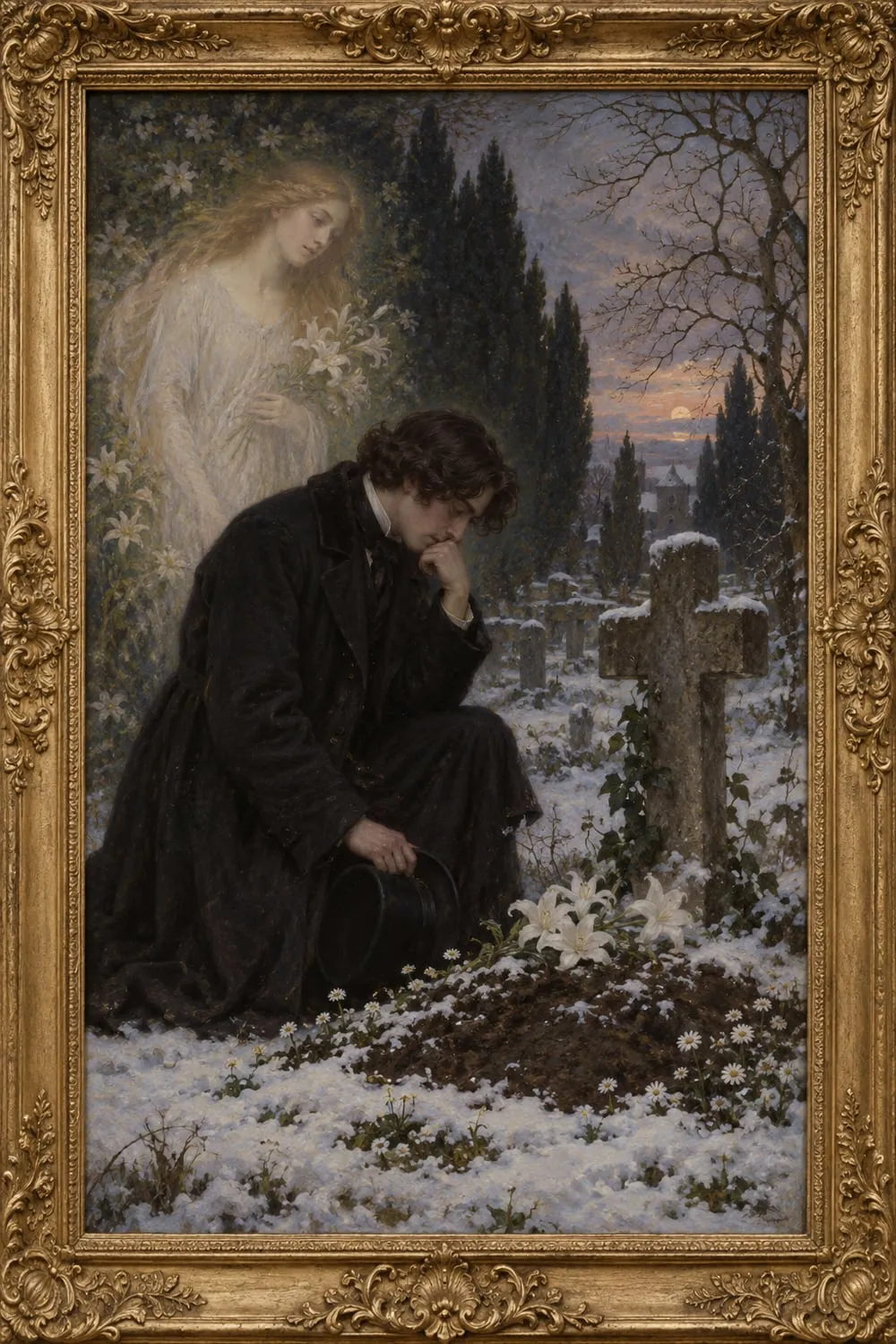


Summary
The title means 'New Life'. The sonnet opens on a bleak shore: 'I stood by the unvintageable sea', a sea that can bear no harvest, while the waves drench the speaker's face and hair with spray. 'The long red fires of the dying day' burn in the west, the wind pipes 'drearily', and the 'clamorous gulls' flee to land.
He cries out: 'Alas! my life is full of pain', and asks who can gather fruit or 'golden grain' from 'these waste fields which travail ceaselessly'. The land of his life, like the sea before him, labours without yielding anything.
The last six lines turn to fishing. His nets gape 'with many a break and flaw', yet 'Nathless' he throws them into the sea as his 'final cast' and waits 'for the end'. Then comes the reversal: 'When lo! a sudden glory!' From 'the black waters of my tortured past' he sees 'The argent splendour of white limbs ascend'. The poem stops at the moment of vision, without naming the figure that rises, and leaves the title to explain it as the start of a new life.
Characters
The speaker
The despairing fisherman
A man standing by a barren sea at sunset, drenched and weary, who feels his life has been pain and waste. Like a fisherman with torn nets he makes one 'final cast' and waits for the end, and is answered by a vision rising from his own dark past.
The rising figure
The sudden glory
The unnamed vision that ends the poem, seen only as 'The argent splendour of white limbs' ascending from 'the black waters'. It comes without warning at the moment the speaker has given up, and the title presents it as the beginning of a new life.
Themes
Despair turned to renewal
Almost the whole sonnet is darkness: a barren sea, a dying day, a dreary wind, a life 'full of pain'. The turn arrives only in the twelfth line with 'When lo! a sudden glory!' The title, shared with Dante's book about his love for Beatrice, names what follows: a new life born out of 'the black waters of my tortured past'. The change is sudden, a gift rather than a reward.
The last cast of the net
The broken nets recall the Gospel fishermen who toiled all night and caught nothing until Christ told them where to cast. The speaker throws his torn nets 'as my final cast' and 'waited for the end', and what rises is beyond anything a net could hold. The image makes hope an act of persistence: he casts again although the nets are ruined.
Beauty as salvation
What rescues the speaker is not a voice or a word but a sight: 'The argent splendour of white limbs'. The poem does not say whose limbs they are. It is enough that they are white, silver and rising, set against the red sunset and the black water. The vision is physical and radiant, and its appearance alone ends the poem.
Context
Vita Nuova is a sonnet in the Rosa Mystica group of Wilde's Poems (1881). Its Italian title, 'New Life', is also the title of Dante's early book about his love for Beatrice. Wilde returns to Dante and Beatrice in Madonna Mia, the sonnet that follows it in the same group.
About this edition
- Text: the complete work from Standard Ebooks, released into the public domain (CC0 1.0). We change only the layout.
- Download the EPUB of the whole book it comes from, free, for any e-reader.
- Every quotation and glossary word in these notes is checked against the text.